
Tesco’s China Failure: The Cultural & Operational Gaps U.S. CEOs Must Avoid?
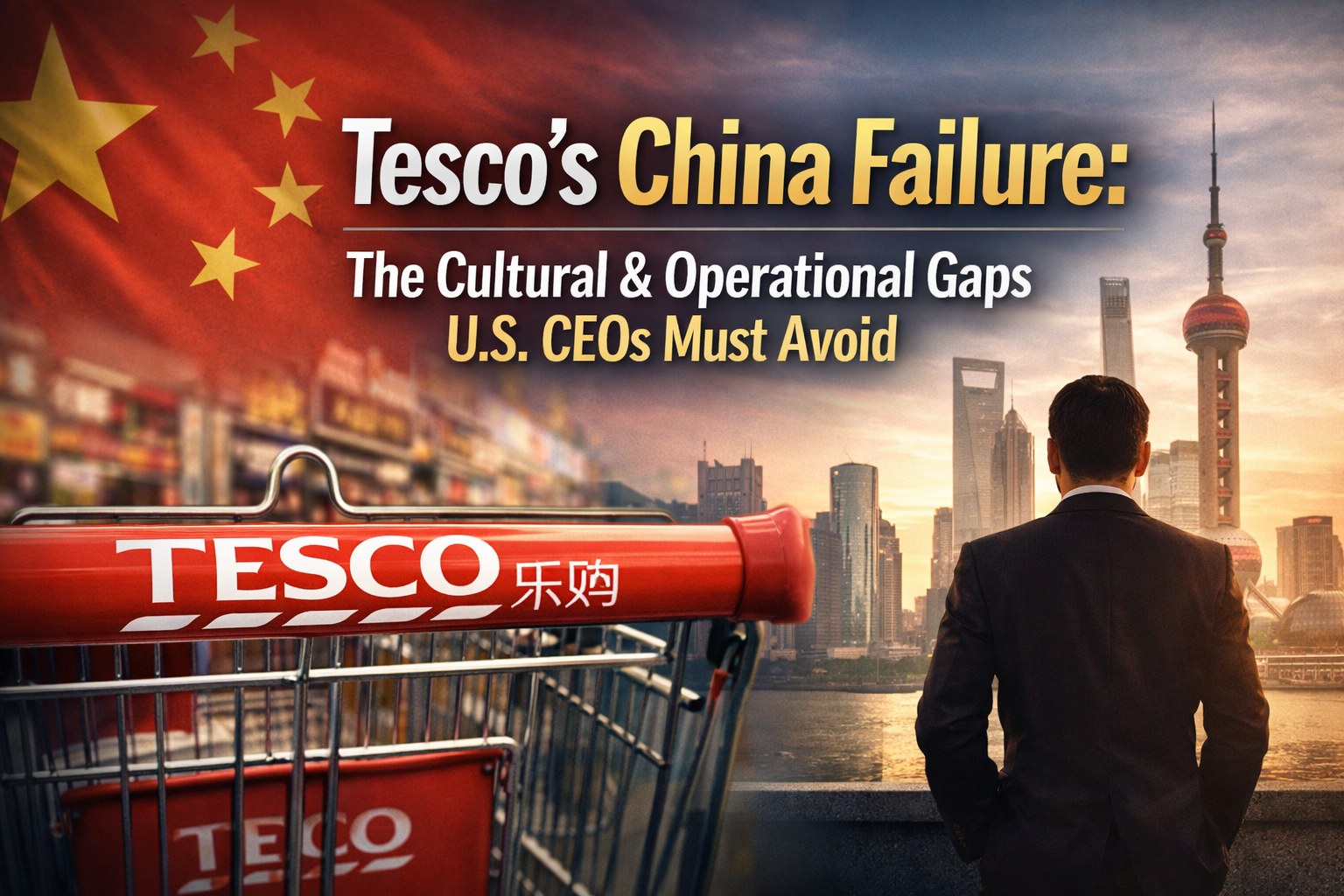
China has long served as a proving ground for global ambition and a graveyard for misplaced confidence. Western firms that fail there often attribute their retreat to regulatory opacity or cultural distance. Yet such explanations tend to obscure a more uncomfortable truth: many failures arise not from external hostility, but from internal misjudgment. The case of Tesco is instructive precisely because it involved no shortage of capital, competence, or patience.
Tesco’s withdrawal from China after nearly a decade of operations was not a collapse but a slow recognition that its model, however successful elsewhere, was structurally misaligned with local realities.
For U.S. CEOs, founders, and strategy leaders weighing expansion into China or any market marked by cultural density and rapid institutional change must learn Tesco’s experience which offers a rigorous test of assumptions that often go unexamined until it is too late.
Why did Tesco enter to China’s market?
At the time of Tesco’s entry in 2004, China represented a compelling convergence of scale and momentum. Urbanization was accelerating and disposable incomes were rising, but the retail sector remained fragmented, with ample room for consolidation.
Tesco has already demonstrated an ability to internationalize its operations across Europe and parts of Asia, adapting enough to local conditions while preserving core efficiencies. The company’s thesis was internally consistent that global procurement would deliver cost advantages then private-label products would enhance margins.
Moreover, Tesco considered that advanced inventory systems would reduce waste and improve turnover and even a joint venture with a local partner would mitigate cultural and regulatory risk. Expansion would be measured, avoiding the excesses that had undone more aggressive entrants. From a boardroom perspective, the strategy appeared disciplined and defensible. But the board underestimated the degree to which China would resist assimilation into an imported logic of retail.
What did happen to Tesco in China?
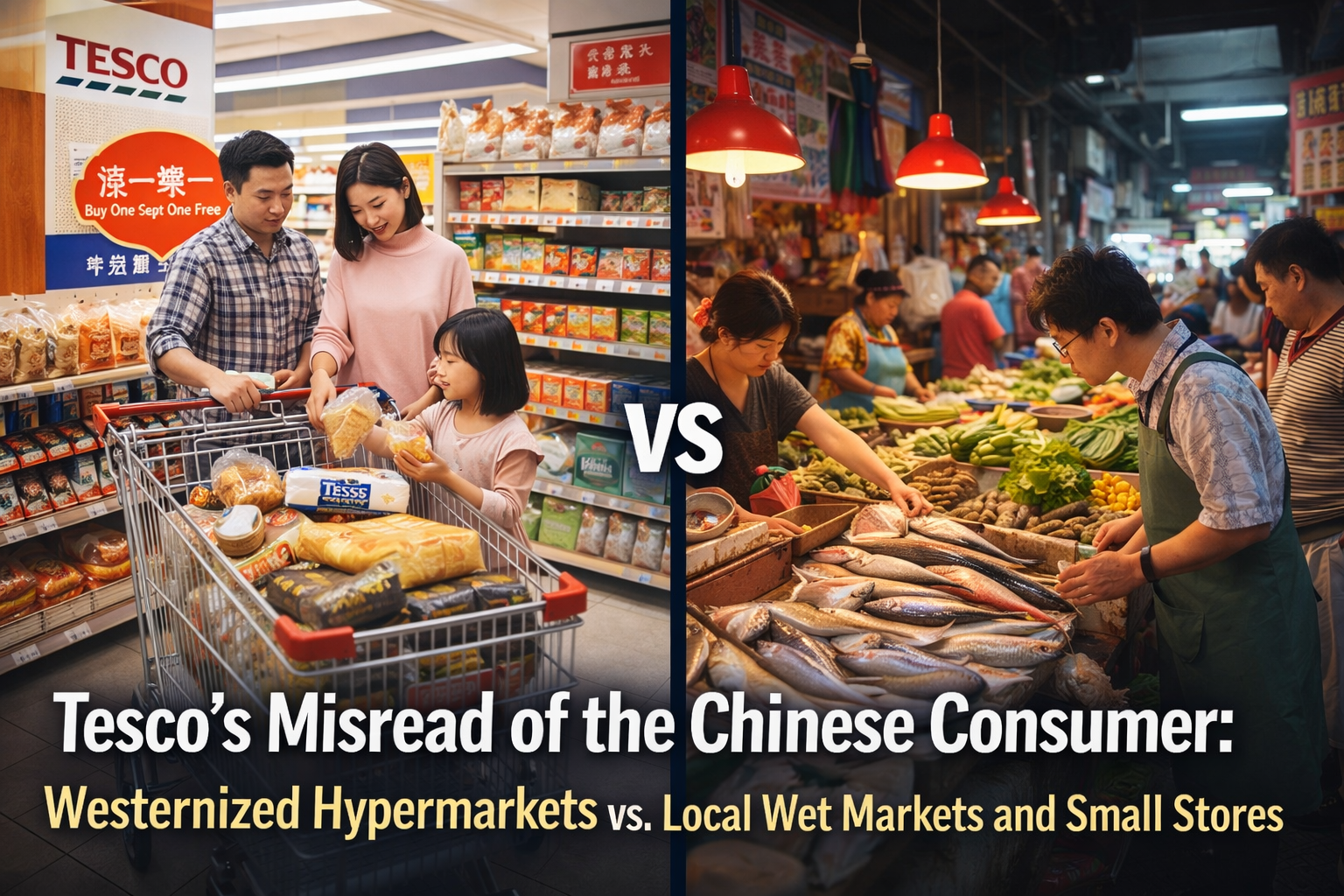
The most consequential miscalculation can be highlighted in Tesco’s reading of consumer behavior. The company assumed that Chinese shoppers would gradually adopt Western purchasing patterns, shifting toward weekly bulk shopping and developing trust in private-label goods. Instead, consumption remained anchored in daily routines, with an emphasis on freshness, visual inspection, and established brands. Wet markets and small local stores retained not only relevance but emotional credibility, something Tesco’s standardized environment struggled to replicate. This disconnect was reinforced by store format choices. Tesco’s hypermarkets, designed to maximize basket size and operational efficiency, were ill-suited to dense urban settings where proximity and speed mattered more than scale. Meanwhile, local competitors responded with smaller formats and flexible assortments, embedding themselves into neighborhood rhythms. Tesco’s footprint, by contrast, reflected a strategic preference rather than consumer demand.
Operationally, the company found itself constrained by its own strengths. Centralized decision-making, a hallmark of Tesco’s success elsewhere, slowed adaptation in a market where conditions shifted rapidly. Local managers operated within frameworks that prioritized consistency over experimentation. While Tesco optimized processes, domestic players iterated business models for such an environment, precision loses out to agility. The final, and perhaps decisive, failure concerned digital transformation. As China’s retail ecosystem moved swiftly toward mobile payments, platform-driven commerce, and data-centric personalization, Tesco remained focused on refining physical retail operations. The assumption that digital services could be layered onto an existing model proved costly. In China, digital infrastructure did not support retail, but it redefined it.
Why does this matter for U.S. Companies?
Tesco’s experience resonates strongly with challenges faced by American firms. Many U.S. companies continue to approach international expansion as a question of execution rather than reinvention. Strong brands, proven operating models, and managerial expertise are assumed to be portable assets. China exposes the fragility of that belief. The strategic cost of misalignment extends beyond a single market. Prolonged underperformance absorbs senior leadership attention, distorts capital allocation, and weakens organizational credibility. For companies operating under investor scrutiny and geopolitical uncertainty, the tolerance for such drag is diminishing. Expansion strategies that fail to account for deep structural differences risk becoming long-term liabilities rather than growth engines.
Key Lessons for U.S. CEOs
The central lesson of Tesco’s China experience is that markets do not converge on western terms. Cultural difference is not a temporary obstacle but a permanent condition. Operating models built around scale, standardization, and predictability must often be reconstructed to survive in environments that reward speed, local insight, and ecosystem integration. Localization confined to surface-level adjustments, offers little protection against structural mismatch. Equally important is the role of leadership. Local executives must possess genuine authority to reshape strategy, not merely execute directives. Without that autonomy, organizations mistake presence for participation. Finally, Tesco’s withdrawal underscores a discipline often overlooked in discussions of growth: the ability to exist decisively when evidence accumulates that alignment is unattainable.
Tesco did not fail in China because it lacked intelligence or resolve. It failed because it assumed that success elsewhere conferred on a right to succeed again. For U.S. CEOs, the more pertinent question is not whether expansion is feasible, but their organizations are willing to transform deeply enough to justify it.
CTA
Executives facing similar decisions will recognize that Tesco’s experience is rarely unique. The same patterns such as misaligned models, delayed adaptation, underestimated complexity recur across markets long before making them visible. For leadership teams evaluating expansion, restructuring, or exit in China or comparable environments, an independent strategic review can help determine whether recalibration or withdrawal is the more disciplined course. A confidential discussion at this stage often proves less costly than learning through experience alone.
At our S72 Marketing Services, we help brands avoid these pitfalls by aligning market entry strategy, positioning, and performance execution before significant marketing investment is deployed. Our approach prioritizes relevance first through localized go-to-market frameworks, platform-specific digital strategies, and real-time performance analytics so expansion decisions are grounded in how consumers behave across ASEAN and U.S. markets.
If your brand is planning to enter a new market or scale existing operations, now is the time to build relevance in the right way. Explore our services or connect with the S72 team to discuss how we can support your growth strategy with data-driven, locally informed execution by claiming 45 minutes consulting section with free of charge.
Conclusion
Tesco’s experience in China illustrates a recurring failure of global strategy: the belief that success is transferable without transformation. The problem was not execution, but misalignment between an imported operating model and local realities. China, like other complex markets, exposes such gaps with efficiency. For U.S. executives, the lesson is clear proving expansion demands not only capital and patience, but a willingness to redesign assumptions, redistribute authority, and exit decisively when alignment proves elusive. Firms that treat unfamiliar markets as extensions of past success risk discovering, too late, that adaptability is the true source of advantage.